- Nouveau
- Rupture de stock
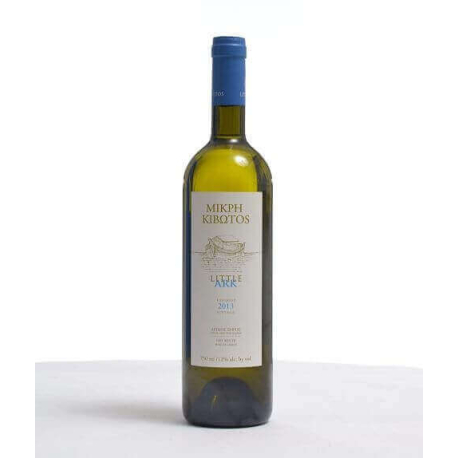

Here's a dry Greek white wine that deserves your full attention. Little Ark, from the Lantides Estate, blends two indigenous grape varieties : Assyrtiko and Malagouzia. The former brings mineral tension, the latter aromatic generosity. This results in a precise wine with a profile that is both straightforward and charming. This IGP Peloponnese wine will be a fine alternative to white wines from the South of France .
Ce produit n'est plus en stock


Satisfait ou remboursé

Paiement sécurisé

dès 100 € d'achat
Fiche technique
| Millesime | 2024 |
| Volume bouteille | 0.75 |
| Type | White |
En savoir plus
The Lantides Estate , also known as Ktima Lantides , is located in the Nemea wine region , in the heart of the Peloponnese , about 30 kilometers southwest of Corinth . Founded in 1993 by oenologist Panikos Lantides , it is a family-owned and still independent winery.
Originally from Morphou on the island of Cyprus, Panikos Lantides left his native country in 1970 to study oenology in Montpellier , then deepened his viticultural knowledge in Bordeaux . His career began in Greece, where he became head oenologist for several renowned wineries in the regions of Nemea , Attica and Mantinia .
He quickly decided to forge his own path. After an initial experiment on a small plot in Attica, he returned to Nemea , drawn by the rich soils and the local microclimate. It was there that he founded Lantides Estate in 1993. He first planted Chardonnay , a grape variety of interest to foreign markets, and then, the following year, Agiorgitiko , which would become the estate's signature red wine. He would later add other varieties, with a constant objective: to showcase Greek grape varieties with exacting standards and precision .
Today, the estate cultivates approximately 70 hectares of owned vineyards , in addition to 20 hectares cultivated in partnership with neighboring winegrowers .
Located in the municipality of Nemea , about 35 km from Corinth , ****in the northeast of the Peloponnese , the Lantides estate extends between Xerokampos and the neighboring Skotini valley .
The red grape varieties are mainly planted on the higher slopes of Asprokampos , between 600 and 650 meters , in an isolated, well-ventilated area where cool nights promote slow ripening and the preservation of natural acidity . For the white wines , the vines occupy the gentler slopes of Skotini , in the Argolid region , at around 550 meters above sea level , on well-drained land with a slightly milder climate.
The climate is Mediterranean , tempered by a continental influence : abundant sunshine, regular breezes, and significant temperature variations . This contrast plays a key role in defining the style of the estate's wines. The soils , predominantly clay-limestone , also include some sandier areas.
At altitudes between 550 and 650 meters , on windswept slopes , the vines benefit from the coolness to produce wines that are ripe, precise, and balanced . Lantides also cultivates other Greek grape varieties such as Agiorgitiko , Xinomavro , and Moschofilero , as well as international varieties like Chardonnay , Cabernet Sauvignon , and Merlot .
The estate produces nearly 200,000 bottles annually , approximately half of which are sold outside of Greece. Its primary markets remain the United States, Canada, the United Kingdom, Belgium, Germany, Switzerland, and Austria . Vineyard management follows a sustainable approach : reduced treatments, close monitoring of individual plots, and respect for biodiversity.
The grapes are harvested by hand , followed by rigorous sorting directly in the vineyard to retain only the healthy grapes. Each grape variety then benefits from a tailor-made vinification process :
The Peloponnese forms the southernmost tip of mainland Greece. It is an ancient wine-growing region, characterized by a contrasting geography: more than fifty peaks rise above 1,000 meters , interspersed with valleys, plateaus, and coastal areas. This diverse topography creates a wide variety of microclimates , ideal for viticulture. It allows for significant temperature variations between day and night, which helps preserve the freshness and acidity of the wines. The proximity of the Aegean Sea and the Gulf of Corinth adds a maritime influence that moderates summer temperatures. Several PDOs (Protected Designation of Origin) are located here, such as Nemea , Achaea , and Mantinia , situated at higher altitudes.
Established in 1989 , the Peloponnese PGI (ΠΓΕ Πελοπόννησος) covers the entire peninsula. It encompasses seven regional units : Argolis, Arcadia, Achaea, Ilia, Corinthia, Laconia, and Messenia. It is one of the largest and most diverse designations in the country. Unlike PDOs, this PGI offers greater stylistic freedom . White, red, and rosé wines are produced, ranging from dry to sweet, sometimes lightly sparkling. Indigenous grape varieties are by far the most prevalent—approximately 90% of the plantings —including Agiorgitiko, Moschofilero, Roditis, Assyrtiko, and Kydonitsa.
The reds are generally vinified at controlled temperatures, sometimes with aging in oak barrels. The whites are crafted to preserve aromatic purity and freshness, with some cuvées exhibiting excellent aging potential. The IGP also permits the moderate use of international grape varieties such as Chardonnay, Syrah, or Cabernet Sauvignon, most often in blends, always with attention paid to balance and the Greek character of the wines.
This wine comes from the Scotini Mountains plateau , located in Argolid , in the northeast of the Peloponnese , at an altitude of 600 meters . The soil there is reddish clay , typical of this high area, which is favorable to the slow ripening of the grapes and to a beautiful natural freshness.
Here's a dry Greek white wine that deserves your full attention. Little Ark, from the Lantides Estate, blends two indigenous grape varieties : Assyrtiko and Malagouzia. The former brings mineral tension, the latter aromatic generosity. This results in a precise wine with a profile that is both straightforward and charming. This IGP Peloponnese wine will be a fine alternative to white wines from the South of France .